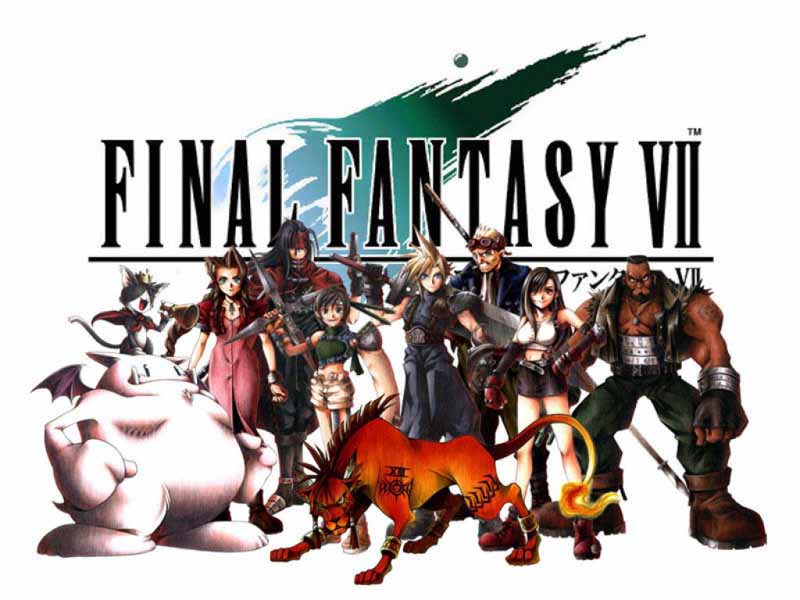
The year was 1999. Everyone was terrified their computer would forget what year it was, dial-up internet sounded like two robots buttfucking over a telephone, and bleached hair tips were all the rage. I, of course, couldn’t have cared less about any of this. This was the year I was getting a PlayStation for my birthday.
My parents owed me, after all. They had just moved me away from all my friends and dropped me into a new school, a new neighborhood, and an entirely new life. I’d already missed out on the N64 and was still playing Donkey Kong on my SNES while kids at school discussed Ocarina and GoldenEye like the fate of the world was depending on who was best at four player split screen.
Not this time. I wasn’t about to FOMO my way through another generation of video games. I was getting a PlayStation, and I was going to be one of the first of these little stinkers to experience what was obviously the greatest-looking video game ever created.
Ape Escape.
I had no idea that another game sitting in my PlayStation library was eventually going to matter to me far more. But first…I have some fucking monkeys to catch.
Now, I have never played a Final Fantasy game before. I didn’t know anything about the series. Hell, I’d never played an RPG before. That would quickly change because to say Final Fantasy VII was a mesmerizing experience would be an understatement.
From the moment I was dropped into this dystopian, cyberpunk nightmare of a city as a badass mercenary-for-hire carrying a sword roughly the size of my refrigerator, with this epic musical score swelling in the background, I was completely fucking sold. And I hadn't seen anything yet.
I was nowhere near prepared for the story that was about to unfold—or for the philosophical shit it would dump on my young brain to process. Identity, death, morality, spirituality, environmentalism, corporate greed, and the nature of memory and free will.
I didn't have words for any of that yet. I just knew that I couldn't stop playing. It consumed almost all my free time.
I’d rush through family dinners just to get back to it. I’d bring my memory card to friends’ houses so I could casually—and by casually, I mean very deliberately—humble-brag about my progress. I’d piss off my sister by hogging the phone line so I could scour the internet for walkthroughs and fanart.
Homework became more of a suggestion than an obligation. Final Fantasy VII nearly caused me to fail the sixth grade. So, academically speaking, this game had already made an immediate and measurable impact on my development.
I became completely immersed in the world, the characters and its lore. This was the first game that made me feel this emotional attachment to its characters and their plight. Cloud was the coolest human being I'd ever seen. Sephiroth terrified the absolute crap out of me. Aerith was my first polygonal crush (and subsequent heartbreak). And somewhere along the way, Final Fantasy VII stopped feeling like a video game I was playing and started feeling like a world I was temporarily living in.
And these weren’t even the only ideas Final Fantasy VII apparently thought I was qualified to wrestle with. Before getting into the two themes that stuck with me the most, I feel like I need to hand out a few honorable mentions to just some of the other strong contributors to my rapidly developing existential crisis.
There was grief, and the genuinely cruel way the game made Aerith’s absence something you didn’t just watch—you had to play through it. She wasn’t simply a character who disappeared from the story; you lost the party’s most naturally dedicated healer, someone the programmers designed intentionally to feel that loss as you played forward. The empty space she left behind existed mechanically as well as emotionally. The game didn’t just tell me someone was gone. It made me feel what it meant to continue without them.
Then there was Wutai, a once-proud nation defeated in war by Shinra and transformed into a tourist destination—a story that, looking back as an adult, carries uncomfortable echoes of real histories of imperialism and places such as Hawaii, where the Hawaiian Kingdom was overthrown and the islands were later annexed by the United States. Suddenly, Yuffie stealing my Materia wasn’t just an irritating side quest; underneath it was a young girl watching her culture become something tourists came to take pictures of and vacation.
And, of course, there was Cid Highwind, whose character arc introduced another important lesson about the human condition: Maybe don't take your shattered dreams out on your girlfriend. Or wife…Or assistant…or whatever the hell Shera technically was to him. Look, relationships in 1997 were complicated.
Final Fantasy VII had plenty more to say, but the two ideas that burrowed deepest into my brain were the ones I probably understood the least at the time. It could be argued that my existential crisis stemmed from the same question at two different scales:
Who am I when the identity I’ve constructed falls apart?
Who are we when humanity stops imagining itself as the center of everything?
At the time, I was this scrawny kid with a ridiculously high metabolism at a new school learning to make friends again and it was a struggle. I couldn't gain weight no matter what I did, and other kids made sure I knew of it. I was teased, I felt weak. I wasn't athletic. My insecurities flourished and when you're young, those things don't stay neatly contained as observations about your body. They start quietly becoming observations about your worth.
Who are you when the story you tell about yourself isn’t entirely true? How much of identity comes from memory, trauma, the people you surround yourself with, aspire to be and the person you so desperately want to become? These are questions I never sat with before and Cloud’s journey ultimately is about just that. It’s about piecing together a fractured self and deciding how to live forward.
I trusted Cloud. Completely. More than that, I wanted to be Cloud.
This impossibly cool, motorcycle-riding, monster-killing mercenary with spiky blond hair, was an elite Soldier that fought alongside the legendary Great Sephiroth. If he didn’t have that big buster sword, he’d need a big bat to swing all this pussy off him. Men wanted to be him and girls wanted to be with him. Of course I wanted to be this guy.
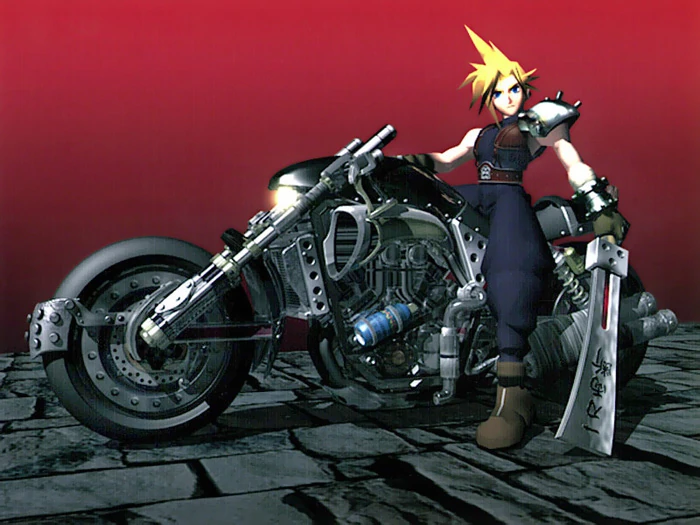
Which makes what Final Fantasy VII eventually reveals about him so much more meaningful to me now. Underneath the SOLDIER persona and the giant sword was someone who had also spent much of his life feeling weak and inadequate. He wanted desperately to become stronger, to become someone important, and when reality didn't live up to the person he thought he was supposed to be, his identity fractured around that ideal.
I obviously didn't understand all of that as a kid. I just knew that the person I'd spent the entire game looking up to was suddenly falling apart. And I fucking hated it.
I kept wanting Cloud to snap out of it. I got angry at him. Every time he did something increasingly insane, I defended him long after the game was giving me reasons not to trust his version of events.
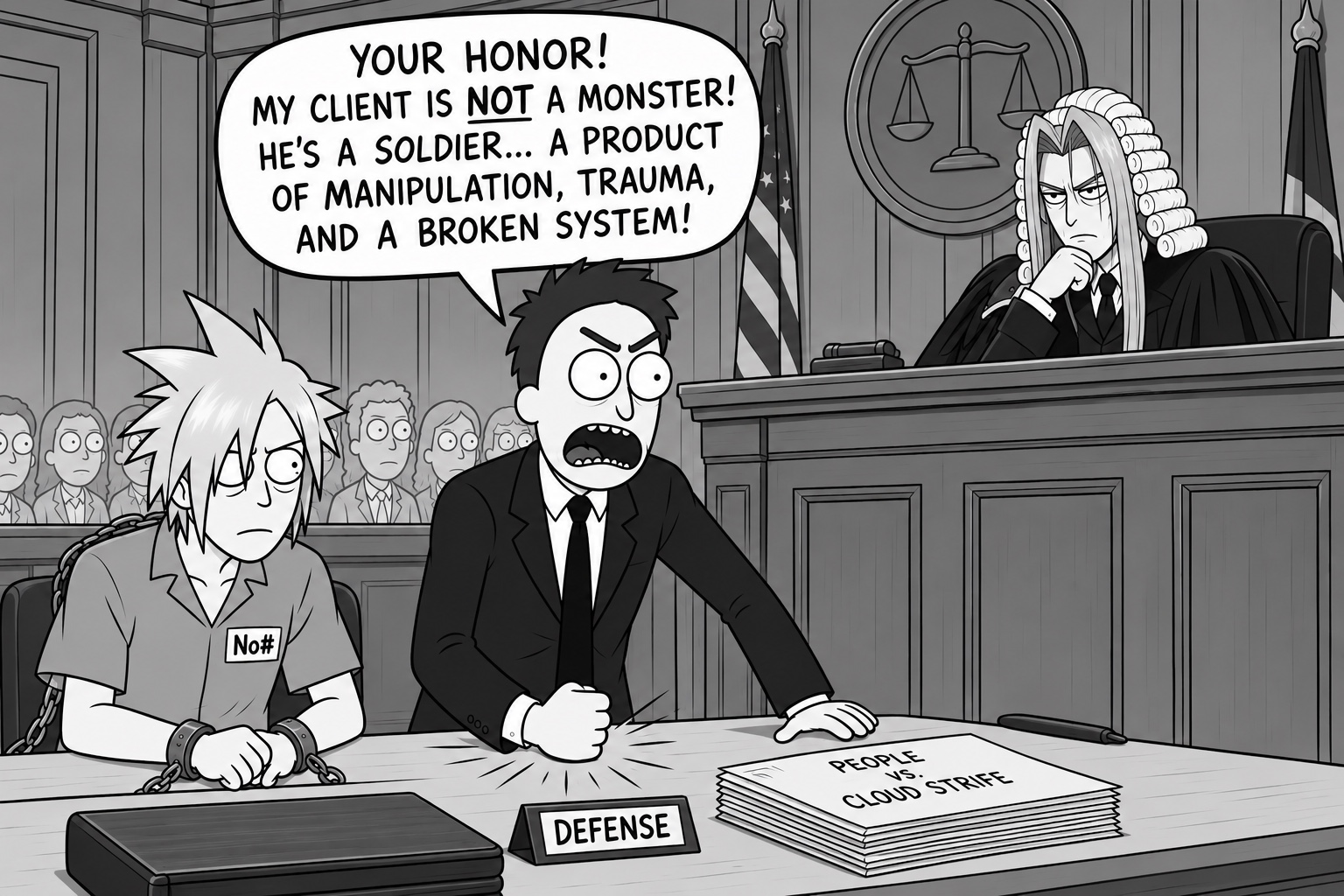
Cloud wasn't just becoming an unreliable narrator; he was turning me into an unreliable witness. I'd spent so many hours believing in this guy that admitting he didn't know who he was felt strangely like admitting that I didn't know either.
“He’s fine. He’s got this.”
Cloud hits Aerith up with a battery and gives Sephiroth the Black Materia.
“He doesn’t got this.”
Now I know it wasn’t really Cloud doing this it was the will of Jenova, and he was being summoned blah blah blah, but I didn’t feel like I was controlling Cloud anymore. I was emotionally stewing in the passenger seat, screaming:
“DUDE, WHAT THE FUCK IS THIS DORK DOING?!”
All the while, I was making excuses for him and insisting to everyone that he was still a competent leader.
“Oh, he is just grieving from the loss of Aerith.”
“What?! No, he always grabs his head with both hands and seizures uncontrollably to his knees like that when he is thinking really, really, hard.”
“Ok give the guy a break, he just spent fifteen minutes on a dang dolphin trying to jump onto an impossibly small beam, and now he has to lead an inaugural parade for his old boss’s son. Your memory’d be fuzzy too!”
And maybe that's why the revelation hit me so hard. Cloud wasn't actually the person I wanted to be. He wasn't the effortlessly confident badass I'd imagined. He was insecure. He carried shame about his past. He constructed an identity around the person he wished he had become because, somewhere underneath all that armor, the person he actually was didn't feel like enough.
And that's where Cloud and Sephiroth become not just the best rivalry in videogame history, but as these fascinating opposites to me. Both have their understanding of themselves shattered. Both discover that the stories they've built their identities around aren't what they thought they were. Sephiroth responds by allowing that revelation to consume him. Not only does he develop this God-complex with mommy issues, but he also loses his connection to humanity and turns his pain towards the world.
Cloud eventually does something much harder. He accepts himself. He lets go of the idealized version of himself he had constructed and accepts the boy underneath it—the unpopular kid who wanted the cute girl in town to notice him, who felt too weak to protect her, and who dreamed of becoming as strong as the Great Sephiroth.
But those things were never his weaknesses. His love for his hometown, his family, his friends, and the promise he made to Tifa were ultimately what gave him strength. Cloud becomes more than the hero I thought he was. He becomes human. Flawed, insecure, vulnerable—and somehow far more heroic because of it.
In a final Omnislash—a moment that still gives me chills just writing about it— Cloud doesn’t simply settle the score with Sephiroth. By then, it isn’t really about revenge anymore. He’s finally confronting the shadow that has hung over his entire life: the man he idolized, feared, and once believed represented everything he himself had to become to defeat him. But he only needs to be Cloud. And I thought that was pretty fucking cool.
Cloud didn't teach me that strength meant becoming the person everyone else thinks is strong. He taught me that strength could mean accepting the person you actually are, including the parts you wish were different, and building from them.
Not only that, but this strength isn’t something we always have to find alone. Sometimes it comes from the people who pick us up when we are broken, celebrate our triumphs, and lend us their strength until we can rediscover our own. Cloud and his team saved the world because he allowed himself to need his friends and not fight this fight alone.
But did they really save the world? Which brings me to part two of my Final Fantasy VII-induced existential crisis: What happens when we die and what happens when we learn we aren’t the center of the universe?
Like most kids, I hadn't spent much time contemplating death. At that age, you're still wonderfully oblivious to just how cruel and unforgiving the world can be. And the little understanding of death I did have seemed sufficient.
I was raised Catholic, so the basic formula, as I understood it, went something like this:
Live → Be a decent dude → Die → Eternal heavenly bliss.
Live → Be a shithead → Die → Is that melting flesh I smell?
Now I wasn’t some altar boy washing some pedophile priests’ feet or anything, but I had absorbed enough Catholicism that God, Heaven, Hell, and an immortal soul were simply part of how I understood reality.
Around the same time that church was becoming an increasingly inconvenient interruption to Saturday-night gaming marathons and sleepovers, I had also started actually paying attention to what I was being taught. And the more questions I asked, the less satisfying some of the answers became. Stories that were supposed to fill me with wonder sometimes had the opposite effect. Some felt contradictory, others morally ambiguous, and were just feverishly boring.
Then FFVII handed me an entirely different way of thinking about life and death. A spiritual mythology that fascinated me. And it wasn’t asking its characters to rely entirely on faith.
The Lifestream could be observed. Mako could be extracted from it. Materia could be used to defend oneself and harness the planet’s knowledge.
The Ancients weren’t saying, ‘Trust us, the planet is alive.”
I found myself deeply attracted to this worldview in which spirituality, nature, and observable reality all exist in the same realm. I started wondering whether spirituality had to require believing in answers I couldn't possibly know, or whether the universe could already be strange, beautiful, and mysterious enough to inspire that same sense of wonder. Maybe there was something comforting in admitting that I didn't know—that mystery itself could be meaningful. And for a kid beginning to wrestle with his first real crisis of faith, that possibility felt strangely liberating.
Death wasn’t terrifying in Final Fantasy VII because it wasn't exactly an ending. Nor was individual life permanent. You were temporarily you, but you were also part of something unimaginably larger that existed before you and would continue after you.
And that’s where the game takes that idea one step further:
What if the Planet itself is a conscious entity?
Not alive metaphorically. Alive as something far more profound than a biological organism-a living system that absorbs the memories, knowledge, and experiences of every life that eventually returns to it. Generation after generation adds something to that collective reservoir, allowing the Planet to carry the experiences of countless lives across its almost incomprehensible lifespan. It isn't simply a rock where life happened to emerge; it's a cradle for consciousness, an ecosystem that continually gives birth to new species and civilizations, allows them to experience the universe in their own unique ways, and eventually welcomes those experiences back into itself. Life emerges from the Planet, experiences the world, and returns what it learned. Then the cycle begins again.
The Planet could also recognize when it was wounded—and defend itself. The WEAPONs weren't just an excuse to throw some epic kaiju battles into the mix. They were the Planet's last line of defense, created in response to the threat posed by Jenova and reawakened when the Planet found itself in mortal danger again.
But they weren't created to save humanity. They were created to save the Planet. Human civilization could be just as much a threat as anything that came crashing down from space.
The Planet starts to resemble a gigantic living organism. The Lifestream is its circulatory system. Mako reactors are open wounds draining its lifeblood. Jenova is an invasive case of “Space Herpes”. And WEAPON is the immune response.
Unfortunately for us, Shinra was standing there holding eight enormous Mako reactors and desperately trying not to make eye contact. And that raises a much more uncomfortable question. Throughout most stories about saving the world, “save the world” and “save humanity” mean the same thing. Final Fantasy VII quietly separates them.
What if humanity isn't the world? What if we're simply one species living temporarily within a much larger living system? And what happens if that system decides we're hurting it? That question makes the original ending much stranger than the triumphant ending I expected.
We defeat Sephiroth. Holy confronts Meteor. The Lifestream erupts from the Planet and intervenes. And then... That's basically it.
The original game doesn't immediately give us the traditional victory fanfare, see Cloud and the gang cheers to drinks in 7th Heaven or an extended scene of Barret regretting his green sustainable future when the AC goes out or something.
Instead, it jumps forward 500 years. Red XIII runs with his cubs to a cliff overlooking Midgar. Except Midgar—the enormous industrial monument that dominated the beginning of the game—is now silent. Nature has swallowed it. Trees and vines grow through the ruins. The Planet survived. But did we?
Final Fantasy VII’s expanded universe and stories would show that humanity did in fact, survive the immediate events of the game. Kumbaya! Advent Children are snickering in the background, and Vincent Valentine is polishing up a new pair of pointy golden boots.
But sitting there in 1999, with only the original ending to go off, I didn't know any of that! Sure, I saw the smoke plume suggesting human civilization survived, but Red’s species can use fire too, his tail is a freaking eternal flame. I had to accept that the ending was just open to your own interpretation. And when the confusion subsided and I had time to reflect…I think it was brilliant.
Final Fantasy VII is a story with a remarkably simple idea that we depend on the same world we are capable of destroying.
Earth has been here for billions of years. Modern humans have occupied only the tiniest sliver of that history, and industrial civilization an even smaller one. Yet in that astonishingly short amount of time, we've become capable of altering ecosystems, changing the atmosphere, driving species to extinction and consuming resources on a planetary scale.
Our planet can’t summon an Emerald Weapon when we forget to recycle our beer cans, or sprout the LifeStream to demolish data centers, nature doesn't negotiate with us simply because we're the protagonists of our own story. We aren't separate from the system we're changing. We're part of it. And if we push natural systems far enough, there doesn't need to be some “Conscious Planet deciding humanity has failed” moment. There are simply consequences.
Climate changes. Ecosystems collapse. Resources disappear. The conditions that allowed civilizations to flourish become harder to maintain.
We can keep telling ourselves we're separated from nature, that technological progress exempts us from consequence, and that some generation in the future will figure everything out. Or we can accept what we are: one young species sharing a very old planet with everything else that managed to make a home here and hold ourselves more accountable.
It's strange to think that some of the questions that still occupy my mind today were planted by a video game I discovered when I was just a kid and how relevant it all is still 28 years later. And yet for a game as silly as breeding giant rideable chickens to ride an even faster more colorful giant chicken challenged me to adapt mentally, spiritually, and emotionally into the person I am today.
I have FF7 to thank for that.