After finishing Andor and The Ninth Jedi recently, I felt something I haven’t felt in a while:
My love for Star Wars returned.
And honestly, I didn’t realize how much I’d missed it.
With so much disappointment being pumped out of the Disney-era Star Wars machine, these two projects reminded me of what I loved about Star Wars in the first place—and what made the original trilogy so mesmerizing to me.
It was the writing.
The dialogue.
The acting.
The atmosphere.
This human element behind a story full of quirky aliens and epic adventures in this vast universe.
This is what Star Wars can still be when passion is prioritized over profit.
And then, just when I’m ready to fall in love with it again, Star Wars does what it always does.
It reminds me why we broke up.
So I find myself trapped in the same pattern: my favorite sci-fi franchise disappoints me, I swear I’m finally done, and then I start looking around for a new sci-fi squeeze. Until a new Star Wars cocktease dangles in front of me, and I just can’t look away.
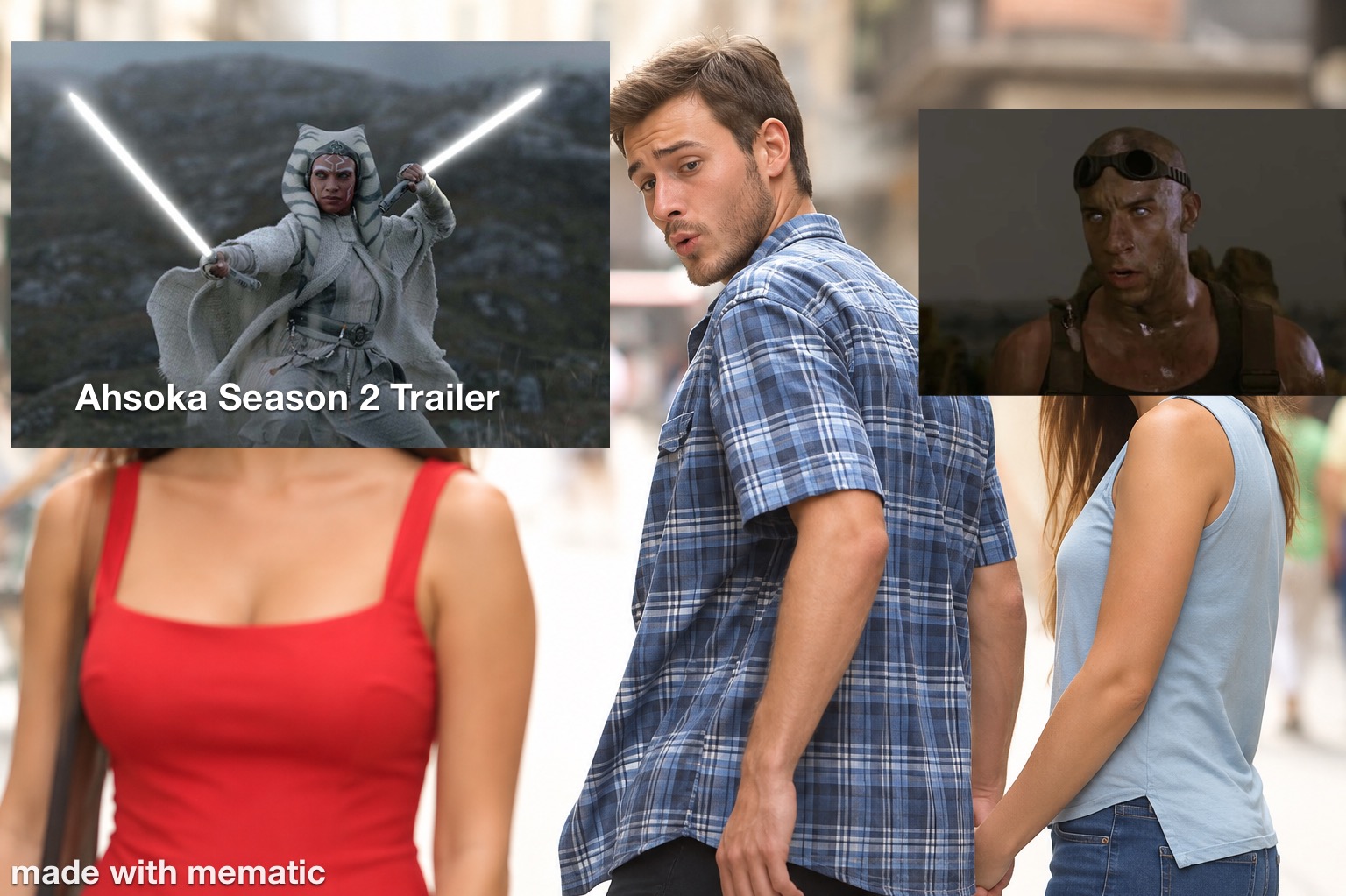
Take The Mandalorian and Grogu, for example.
After finishing Andor, I had high hopes for it. I thought, Okay, maybe this is it. Maybe Star Wars and I are finally ready to work things out.
Instead, I found myself watching what felt like an extremely expensive episode of The Mandalorian that, rather than give me a reason not to regret paying for a Disney+ account, had somehow wandered its way into a movie theater—and nobody had the heart to tell it that it wasn’t equipped for a theatrical release.
I liked The Mandalorian. I really did. But there’s a point where nostalgia stops being nostalgia and starts becoming a hostage situation.
How many times can you bring back a familiar character, location, creature, reference, or piece of lore before the universe starts feeling less like a living galaxy and more like a museum exhibit dedicated to itself?
And this is where Star Wars has started to lose me.
It feels like we’re increasingly afraid to let characters simply be interesting.
Boba Fett was interesting because we barely knew anything about him. Darth Maul was interesting because he was terrifying, mysterious, and didn’t need a twelve-page emotional biography explaining why he was having a bad day. Guess what? Every day for Darth Maul is a bad day! Dude was cut in half and lost down a 100-story fucking trash chute! You think Naboo had custodians on staff during a planetary crisis of that magnitude?!
Sometimes a character can just be an asshole.
Sometimes a villain can just be a villain.
Sometimes a morally complicated character can remain morally complicated without eventually being handed a redemption arc and a heartfelt speech about how, deep down, they were actually a pretty decent Gungan.
Apparently, the Star Wars universe has discovered that nobody is allowed to be mysterious anymore.
Eventually, someone has to explain them.
And explain their childhood.
And explain their motivations.
And explain how they feel about their motivations.
And explain how that is different from Lucas-era characters’ motivations.
And why Disney-era characters’ motivations are better than your childhood memories, you piece of shit.
At some point, just let the weird space guy be weird.
This is why The Ninth Jedi hit me so differently.
It felt like someone finally looked at Star Wars and said:
“What if we just… made some new shit?”
And suddenly, there was room to breathe.
No Skywalker family tree.
No need to explain where every character fits into established lore.
No obligation to resurrect somebody’s favorite character from 1983.
Just a new story, new characters, new ideas, and a familiar mythology that could actually be used instead of worshipped.
Which was something The Last Jedi continuously tried to drill into your head: that this might be the positive new direction Disney could spearhead and focus on midway through the new trilogy… before completely backsliding on that promise and delivering the literary abortion that is The Rise of Skywalker, a film I found so atrociously bad that I had to chisel out this mental image of Palpatine shooting lightning loads into some poor soul. Was that why he was missing from A New Hope and The Empire Strikes Back—because he was too busy plowing some strange? Keep the hood up, Palpy, would you?!
Anyway, visually, The Ninth Jedi is spectacular, which isn’t surprising considering the talent behind it comes from Japanese studio Production I.G, responsible for the Ghost in the Shell series. But what really grabbed me was its story.
The characters were charming. The world felt fresh. The idea of neutrality between Jedi and Sith was interesting. Even the lightsabers themselves were given a new relationship to the emotions and inner thoughts of their wielders.
It felt like Star Wars without feeling like it was desperately trying to remind me that it was Star Wars.
And that’s an important distinction.
Because I don’t actually want Star Wars to stop being Star Wars.
I want it to remember what made Star Wars worth loving in the first place.
A New Hope was so well-written that, in just a two-minute conversation between Luke and Old Ben Kenobi, you learn about the Jedi, Luke’s father, the Clone Wars, the Empire’s conquest, and the living Force in a way that gives you just enough exposition to simmer the pot without boiling it over. Allowing us to critically examine and digest the information without giving away too much lore or disposition is storytelling at its finest.
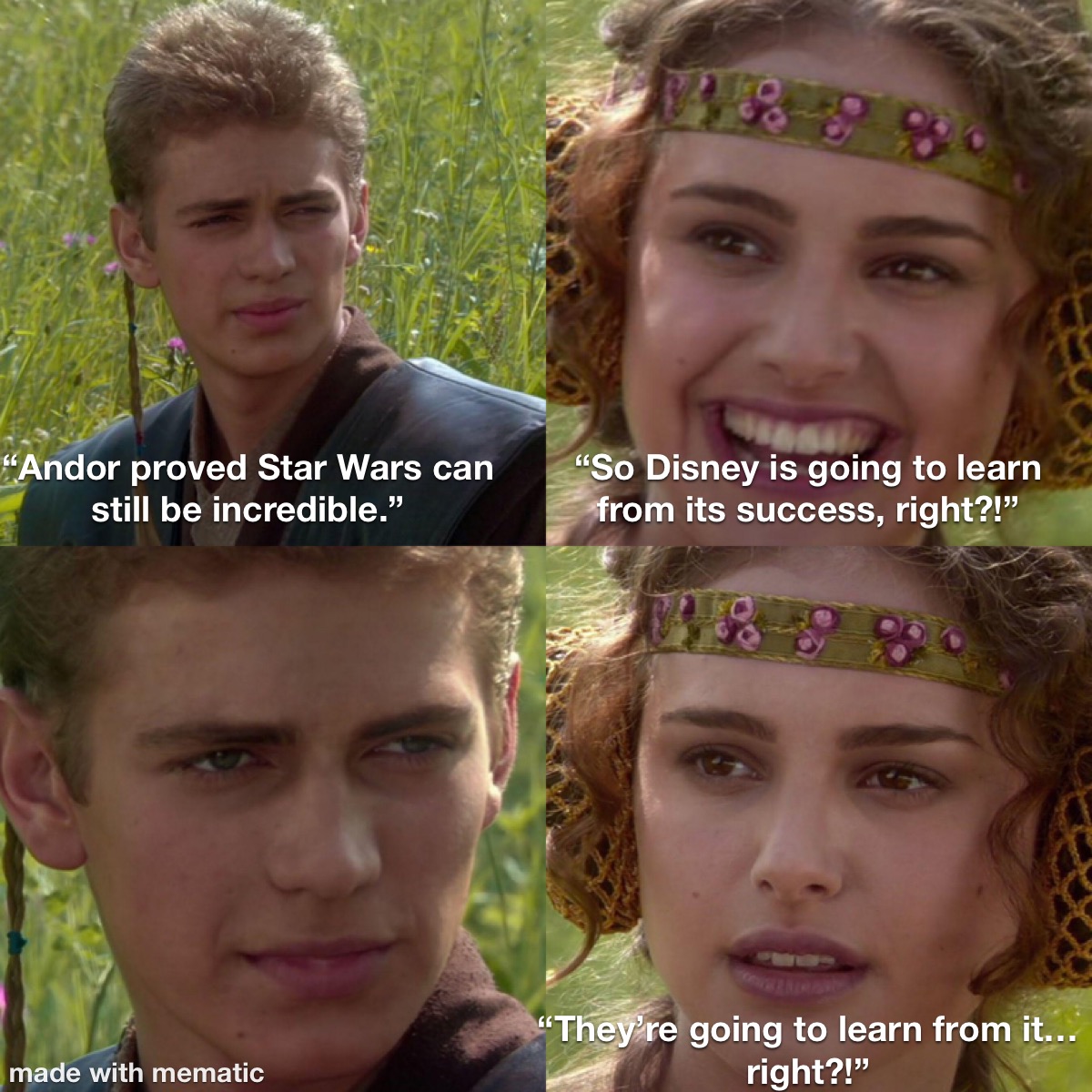
Andor understood this too.
It took the Star Wars universe and stripped away a lot of the mythology we’re accustomed to seeing. No Jedi running around every five minutes. No need for a Skywalker to enter the room and save the day.
Instead, we got politics, oppression, rebellion, fear, sacrifice, bureaucracy, and ordinary people trying to survive under an authoritarian regime.
And somehow, it made the galaxy feel bigger.
That’s the irony.
The more Andor moved away from the familiar Star Wars formula, the more it felt like Star Wars.
It reminded me of watching The Empire Strikes Back.
Not because it copied it, but because it trusted the audience. It was dark, it had substance, and it introduced us to characters we became invested in learning more about—characters we could empathize with, understand their struggles and intentions, and see ourselves through.
It didn’t need to constantly stop the story to explain what an authoritarian government is, why oppression is bad, or what we’re supposed to think about a character.
It simply showed us.
The parallels between Star Wars and our own world have always been one of the most interesting things about the franchise. George Lucas understood that. Beneath the spaceships, laser swords, aliens, and extremely questionable decisions regarding planetary imperialism, Star Wars was always capable of saying something about us.
That’s the part I don’t want to lose.
Because Star Wars has never just been about lightsabers and space battles.
It’s about good and evil.
Power.
Fear.
Hope.
Corruption.
Freedom.
Family.
Faith.
And what happens when people convince themselves that the terrible thing they’re doing is actually necessary.
That’s some pretty heavy philosophical material for a franchise where a tiny green imp can flip a spaceship with his mind.
And that’s exactly why I still care.
The problem is that I don’t want to spend the rest of my life watching Star Wars dig through its own closet looking for something I recognize.
I don’t need another character from the original trilogy.
I don’t need another cameo.
I don’t need another nostalgic reference accompanied by a swelling musical score telling me that I’m supposed to feel something.
Give me something I haven’t seen before.
Give me strange planets.
Give me new philosophies about the Force.
Give me civilizations that have nothing to do with the Skywalkers.
Give me characters who aren’t secretly connected to someone I’ve already met.
Give me stories that take risks.
Because The Ninth Jedi showed me something that I think Star Wars desperately needs to remember:
The galaxy is enormous.
Why are we spending so much time in the same neighborhood?
Maybe leaving the Skywalker era behind is exactly what Star Wars needs.
Maybe the future of Star Wars isn’t about bringing back everything we loved.
Maybe it’s about finally giving someone permission to create something new.
And that’s where I find myself stuck in this stupid relationship.
Because every time I think I’m finally done with Star Wars, it makes something like Andor or The Ninth Jedi.
And suddenly, like a Force persuasion, it convinces me that the baggage was never there. And I’m thirteen again, staring at the screen, completely mesmerized by this galaxy far, far away.
Then the next project comes along, and I’m sitting there thinking:
Jesus Christ. Why did I get back together with you?
Maybe that’s the real tragedy of being a Star Wars fan.
I don’t actually want to leave.
I just want Star Wars to give me a reason to stay.